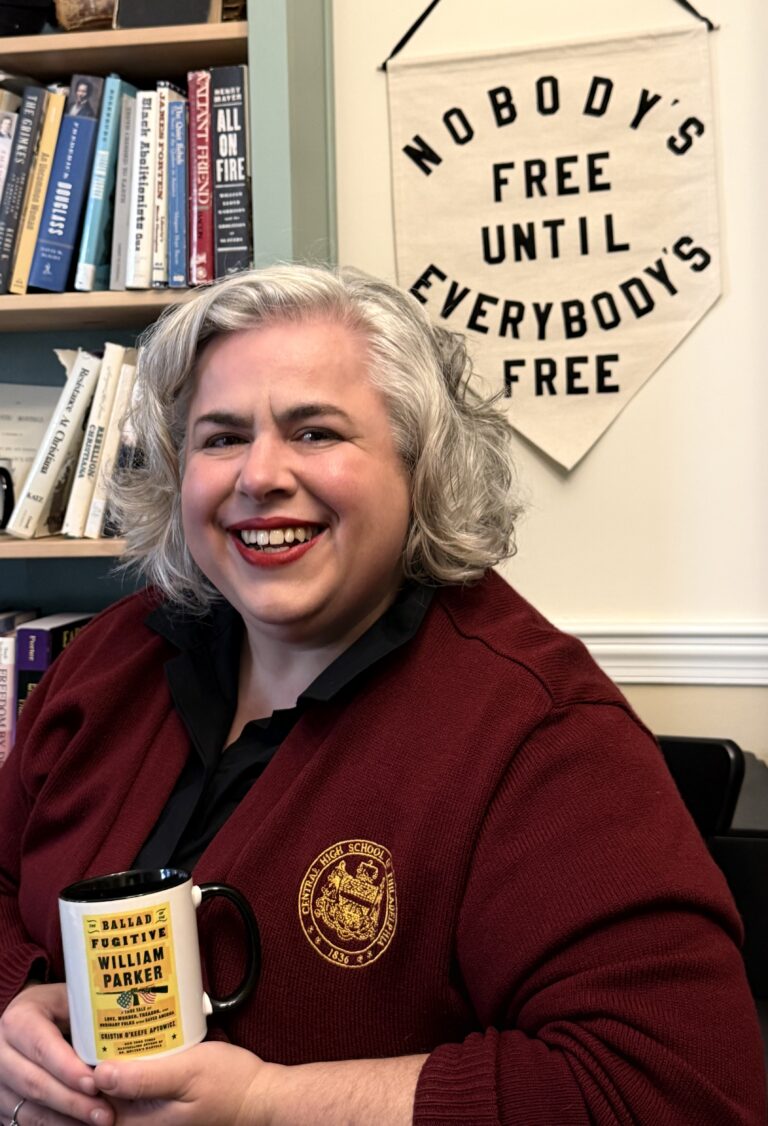
You may know Cristin O’Keefe Aptowicz (255) and member of Central High Hall of Fame as the author of Dr. Mutter’s Marvels, her bestselling biography of the Mütter Museum’s founder, which spent three months on the New York Times bestseller list. Aptowicz is also the author of the upcoming The Ballad of the Fugitive William Parker, a Philadelphia-centered historical nonfiction book being released next month by Simon & Schuster. Publishers Weekly gave the book a starred review, calling it an “impeccably researched page-turner” that “powerfully evokes the American spirit.” Through her work, Aptowicz continues to bring fascinating stories from Philadelphia’s history to life for new generations of readers.
We connected with Cristin to get an insight into how Central shaped the career she is in, the journey of how she started her most current book, and hearing what advice she would like to share with Central High Schools students.
Central & Early Inspiration
Q: Were there any teachers, classes, or experiences at Central that had a lasting impact on your path?
A: My brother Kevin (254) and my sister Caitlin (251) all have kids who graduated from high school this year, and at their joint graduation party we talked about all the schools we attended and what we’d rank as our favorites. My terminal degree was a BFA in Dramatic Writing at NYU, but my brother and sister got undergraduate, Master’s and, finally, PhDs in their respective scientific fields, and all at different institutions. All three of us ranked our experience in Central as being among the top two education experiences we had, with my brother and I ranking Central as number one.
The reasons were manifold. There were the classes, which were rigorous but attuned to student needs. Each of us had stories of successfully advocating to tweak an assignment to more align with our personal interests or POV, and having the teacher not only agree to the change, but encourage us to always champion our own unique path towards knowledge.
There was a culture of Central: my siblings and I confessed it was often the opinions of our peers that spurned our achievements more than our teachers or even parents. Our fellow students were doing incredible things in the classroom, in the science lab, in our literary journals and newspapers, on the court, on the stage, and in the field, and it inspired us to expand what was possible for us and our lives.
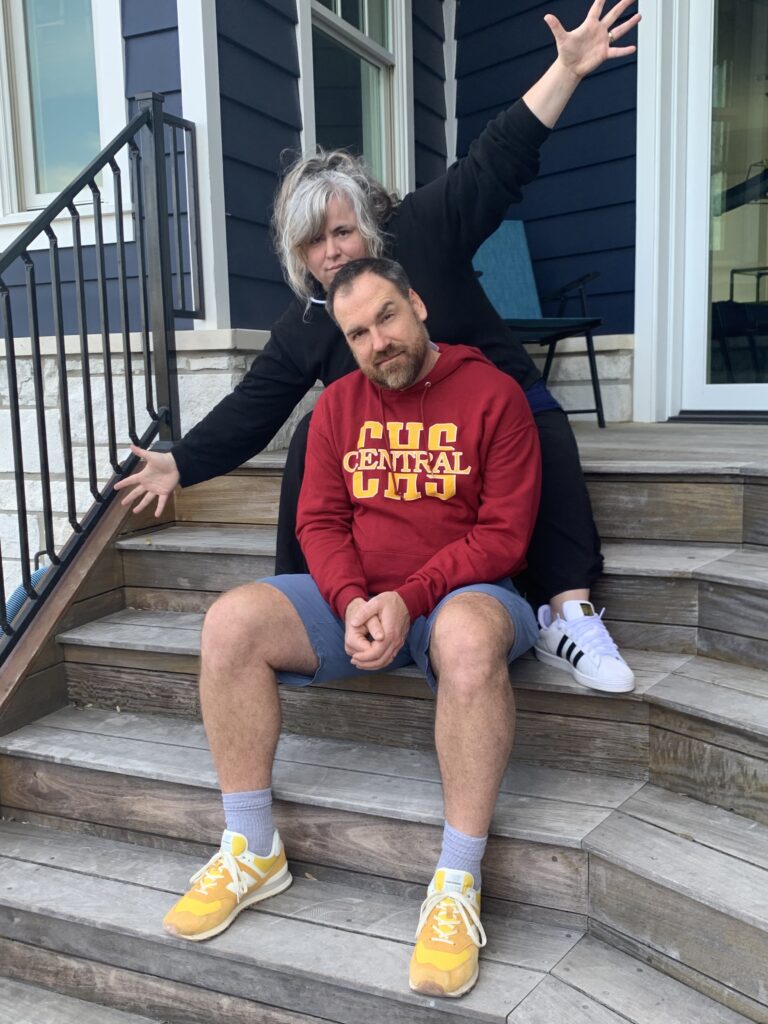
And there was the history of Central, which has endured. You learned early at Central the affections its students and alumni have for “dear old high,” but that only became truer once you graduated. Whenever my brother and I wear our Central gear in the streets of Philadelphia, there is often honks, fist pumps, and a phenomenon by confused Ohio-born husband had termed “Shouting Numbers” where a Wawa check out line becomes a sudden cacophony of folks shouting three digit numbers at each other: “Hey! 225!” “Oh really, 272!” “Oh snap, I’m 248!”
Collectively they have formed an experience we have all grown to cherish and respect as something rare and powerful. I’m so proud of being a Central grad, and so proud of what we as a school have accomplished and continue to accomplish.
Q: Looking back, what skills or values did you develop at Central that have stayed with you throughout your career?
A: There are so many answers I could have to this question, but what I come back to always is this organic curiosity. Central is a magnet school, and thus filled with what others might deem “smart kids.” In my life, I’ve found that a lot [of] “smart kids” cling [to] that identity, never wanting to look “dumb” or that they don’t know an answer.
But my experience at Central was the opposite of that. People were curious, asked questions, challenged each other and the status quo. This attitude could be found in the classroom, of course, but outside it. Multi-cultural day, for example, always served as a glorious celebration of how much more there was to your community than you ever were aware of it.
As a historian, that organic and humble curiosity has served me well, but I think it plays a role in all Central grads. When my brother got his PhD in Physics from Yale (with a thesis dedicated to his Central science teacher), he told me that any success he had wasn’t because he was necessarily smarter than anyone else at his school, but because he seemed more willing than most of peers to ask questions from those he knew knew more than he did. While others in his cohort desperately sought to hide the weakness they saw in their scholarship, Kevin – with that Central curiosity – sought to reach out to others, ask questions, and resolve it.
Q: You attended Central just a dozen years after the first class of women entered the school. Did you have a sense that you were part of a new chapter in Central's history?
A: By the time I arrived at Central in 1992, the student body was pretty evenly split, so I was only aware of Central’s all-boys history when I spoke to my parent’s friends, who were surprised to hear girls were allowed now! But I was there for perhaps the final vestige of Central’s boys-only history. During my senior year, the second to last line in the chorus of the Central School Song was formally changed from “for thee your sons will labor” to “for thee we all will labor.” Our graduating class was the first class to sing that new (and lasting) version at our graduation.
Career & Current Work
Q: Tell us about your professional journey since graduating from Central.
A: When I arrived at Central at age 13, I was already aware that I wanted to be a writer when I grew up. But I had no idea of how to achieve that goal. At that time, Philadelphia had a rule that if you worked for the city you needed to live within city limits. Whole neighborhoods would therefore be populated by firefighters, police officers, sanitation workers and men and women like my father, who spent his whole career at the Philadelphia Water Department. To tell the grown-ups in my neighborhood that I wanted to be a writer was akin to telling them I wanted to be the “Tooth Fairy.” There just was no clear path on how to make that happen.
Central was the first educational institution that helped me see that path. Becoming a staff member, and later one of the editors, of both the Centralizer and the Mirror, gave me my first taste at seeing my work in print… as well as all the effort it takes to make that happen behind the scenes. My English and Creative Writing teachers – shout out to Ms. Nehez, Ms. Hanlon, and Ms. Schroeder – pushed applications into my hands, allowing me to attend the Pennsylvania Governor’s School of Arts for writing, and placing in Philadelphia’s Young Playwrights competition among other incredible, world-shaping opportunities.
But more than that, the culture and community of Central helped me to see the diverse stories that existed in the world, and the diverse audience that should see themselves represented. As I moved forward as both a poet and a historical nonfiction writer, I keep that perspective in mind, and always hope that if a Centralite ever picks up my book, they feel I do the school proud.
Q: What drew you to your current work, and what do you find most rewarding about it?
A: The journey of my forthcoming historical nonfiction book, The Ballad of the Fugitive William Parker: A True Tale of Love, Murder, Treason, and Ordinary Folks Who Saved America began when my brother and I began diving into our mother’s family tree, after she passed away in 2014. We had always been told that side of the family – where I get my middle name: “O’Keefe” – were all Irish Catholic immigrants who arrived as a result of Ireland’s potato famine.
You can only imagine our surprise when we discovered that not only was one branch – starting with my mother’s mother’s mother Mary Price – was German, but that that branch arrived in 1719, making us seventh generation Pennsylvanians!
Our surprise turned to shocked awe when we discovered that [the] Price family tree included numerous active members of the area’s Underground Railroad.
In learning more about my ancestors, I discovered a story that dominated the press in its day, but had faded largely from cultural memory today: The Christiana Riot (now known as the Christiana Resistance).
Shortly after the passage of the 1850 Fugitive Slave Act, Pennsylvania became flooded with enslavers and slave-catchers looking to reclaim human beings who had fled bondage and lived a free life in Pennsylvania. For decades, three groups of radical abolitionists in our area of Pennsylvania–the wealthy free Black elite of Philadelphia, rural Quaker farmers, and the fugitives from slavery who lived and worked in both areas – fought back against injustice and pushed for change. One Lancaster County man, a fugitive from slavery named William Parker, went so far as to rally his neighbors to form a “mutual defense organization” that gathered together Black men and women to confront and battle enslavers and slave-catchers who found their way into their villages and towns.
A little before dawn on September 11, 1851, a Maryland enslaver named Edward Gorsuch arrived in the small village of Christiana in search of four men he considered his property, and found himself standing on William Parker’s front step. What happened next was a stand off, which saw dozens of Black men and women arrive to Parker’s cornfield – drawn there by the sounds of Parker’s wife horn – to make it clear that no man in their community was being taken back to the South. By the end of the standoff, the enslaver and his posse were all either dead, injured, or runoff, and by the next morning dozens of Christiana men were arrested, and soon they would all be charged with Treason.
The resulting trial —which centered on one white man who arrived on the scene and refused to help the enslaver or the U.S. Marshall he hired, in direct defiance of the recently passed Fugitive Slave Act – was front page news for weeks across the country.
That such a story of community, intersectionality, and resistance has been largely forgotten was heart-breaking to me. But I hoped the historical organizations, some of which were populated by descendants of those arrested, were helping to keep the story alive. My book continues these efforts, and I feel honored to be among those fighting to have this story be remembered, reclaimed, and restored to its rightful place in history.
Q: How did you become involved with 1838 Black Metropolis, and what inspired your commitment to its mission?
A: I began my research journey into the Christiana Resistance by reading every book I could find on the subject. Next, I visited Christiana, which hosts a yearly “Heritage Days” and learned how the Christiana Historical Society has been keeping the story alive.
I knew that I wanted to expand the lens of the story. Previous books stuck fairly closely to Christiana, but I wanted to include the Underground Railroad of Philadelphia–whose intelligence network first alerted Christiana residents about Gorsuch’s arrival prior to the standoff, and whose fundraising efforts supported the arrested men and their families as they awaited trial in Philadelphia’s Moyamensing Prison. (The trial itself happened in Independence Hall, with a sitting congressman on the team for the defense, a sitting senator for the prosecution, and a sitting Supreme Court Justice serving as judge!).
When I began researching Philadelphia, I was hoping to find resources which could connect me to the intimate and personal stories of “ordinary” Americans, similar to what I was finding in Christiana. I knew Philadelphia would be able to hook me up with information about bold-faced names like Frederick Douglass, Lucretia Mott, William Lloyd Garrison, etc… but would there be enough resources covering these smaller stories?
I felt like I won the lottery when I discovered 1838 Black Metropolis via their exhibition at the Historical Society of Pennsylvania.
1838 Black Metropolis is a non-profit dedicated to reclaiming and restoring the near-lost history of this vital memory of Philadelphia.
Q: Why do you think the stories and history shared through 1838 Black Metropolis are especially important for today's students?
A: Too often, the story of Black people in pre-Civil War America is seen only through the lens of slavery. But 1838 Black Metropolis shows that free Black Philadelphians not only created thriving, vital, and abundant communities during a time of horrific oppression, but they were foundational in the imagining and the forging of the America we know today.
It made me very proud of our city to see it through the lens of these clever, industrious, and passionate people, and I want to share that feeling with everyone I can.
Q: You're helping create an opportunity to bring 1838 Black Metropolis to Central. What excites you most about reconnecting with your alma mater in this way?
A: As I mentioned, I found multi-cultural days at Central to be so incredibly special. It meant so much to me to have fellow students lift the veil for me to learn more about the culture, their arts, their dress, the cuisines, and their philosophies. I would love to pay that feeling forward by joining 1838 Black Metropolis historians (and fellow Central alum) in sharing stories from Philadelphia’s collective past.
Reflection & Advice
Q: What advice would you give current Central students who are just beginning to think about their futures?
A: One of the lessons I learned from researching my book The Ballad of the Fugitive William Parker is the power of knowing what you bring to the table.
The ancestors I had who were involved in the Underground Railroad were known as seamstresses of the Underground Railroad. My fifth great-grandmother, and her sisters, and sister-in-laws, would gather at one house at night, and create entire wardrobes for families or groups fleeing bondage. They even were known to gender-swap the youngest children–dressing girls as boys, and boys as girls–to help the families avoid matching whatever runaway slave bulletins were created after their escape. I could find no evidence that they housed these families, or helped transport them. But they were known for always being “willing and even desirous to give assistance in this way,” as was written in the 1883 book The Underground Railroad of Chester and the Neighboring Counties of Pennsylvania by R.C. Smedley.
I think too often people believe that they are going to do something, they need to do everything. But my research has shown that the folks with the greatest, most sustained impact were folks who knew what they brought to the table, and they offered their services consistently, and reliably.
So the advice I would give Central students beginning to think of their futures, I would think about what they naturally gravitate towards doing: what they are good at, and what they enjoy doing. And see what ideas spring from there.
Q: Is there a lesson you've learned since graduating that you wish you had known as a student?
A: I have written three books of nonfiction: a history of the New York City poetry slam movement (Words in Your Face); a biography of 19th surgeon who specialized in the severely deformed in a time before anesthesia and whose collection would later form the Mutter Museum (Dr Mutter’s Marvels) ; and now a braided narrative about cross-section of radical Pennsylvanian abolitionists who refused to bow to injustice, resisted all forms of government overreach, and successfully fought for systematic change on the logical and federal level (The Ballad of the Fugitive William Parker). I am often asked what connects these very different stories, and I think the answer is that they all center people who did not request nor receive permission to be who they knew they were destined to be.
Central was such an incredibly affirming experience for me, and I was generously shown time and time again my potential and how far I could go with it. However, if I am honest, I have to admit that often I felt a need to prove that I deserved opportunities that I could have simply embraced without any added stress or overwork.
I wish I learned early the lessons that real life characters in my books taught me: that if to know yourself is to know how you are destined to be, and not let anything – internally or externally – make you doubt that path.
Looking Ahead
Q: What are you hoping to accomplish next, both professionally and personally?
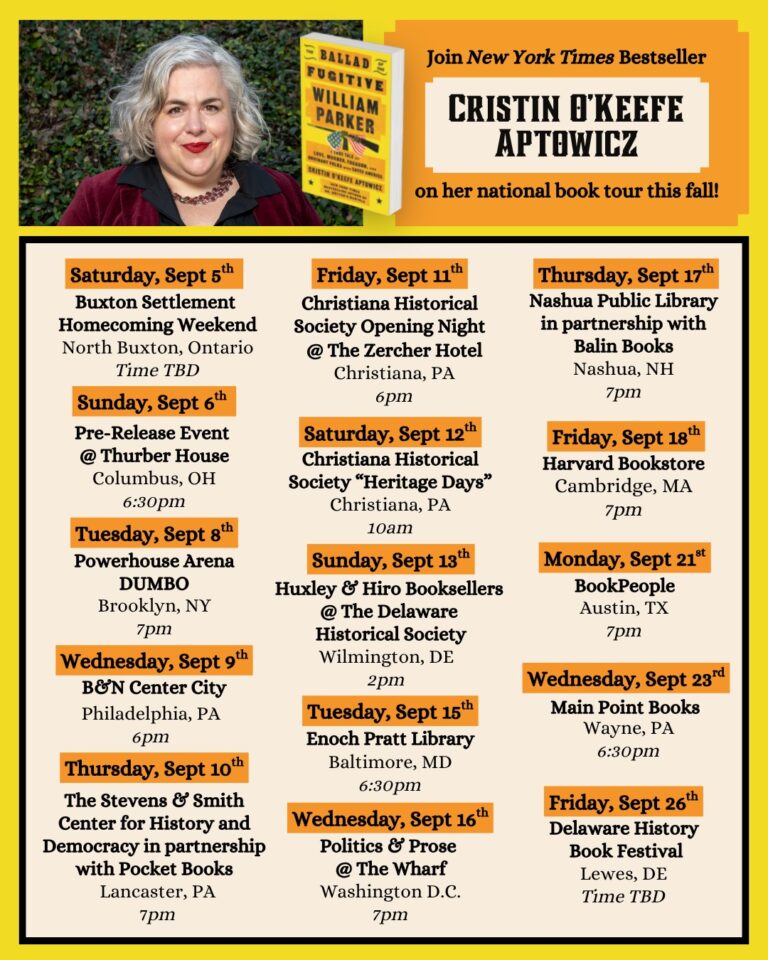
A: I am embarking on a three month tour behind my new book. Being a history writer is such a crazy experience, because you spend so much time alone in libraries and archives, researching and writing, and then once the book is out, so much time on the road sharing what you’ve learned in bustling rooms filled with strangers. But it’s also one of the great joys on the job.
So I am looking forward to this tour, to meeting other Centralites on the road, and enjoy the experience of sharing these stories, before I dive into researching my next one!
Q: How can the CHS community support the work you're doing?
A: I would love to see Central alum at my future book events! Obviously to attend my Philadelphia one at Philadelphia Barnes & Noble – where I will be in conversation with 1838 Black Metropolis founder Michiko Quinones – would be special, but I’ll also be doing events in Lancaster, Christiana, and Wayne Pennsylvania, as well as New York City, Boston, Baltimore, DC, Austin, New Hampshire, and more!
And as a thank you to both the Centralites who come to my events, as a celebration of our alma mater, and as a support for future generations of Central artists, I will be donating $2.55 to Central for every Centralite I meet on tour. I will extend this offer to spouses, children, parents, and siblings of Central alum too! Just let me know on the signing line, and I’ll add your name to the list.
At the end of the tour, I’ll cut a check to support the Capital Campaign, helping to create more educational space for future generations of Central students to find their voices, pursue their passions, and discover their own paths.