
We asked Lee Felsenstein the question, "As someone who helped lay the groundwork for personal computers, what are your thoughts on the evolution of computers and the ways people use them today, particularly in the world of video games?"
Below he shared his insights on the evolution of personal computers and software technology.
Lee Felsenstein (219) (Jan. 1963)
I was instrumental in the formation of the personal computer industry in 1975 and beyond, mostly because I had been able, as an engineer, to explore the question of what a personal computer could be and how it might be put together.
My colleagues in this effort were mostly lower-level engineers (like me), students and technical workers in the crucible that was Silicon Valley in the mid-70’s. A central figure in this milieu was Bob Albrecht, a technical writer who published “People’s Computer Company – a tabloid periodical that served as a focal point for people who wanted to explore these questions.
Albrecht had concentrated on bringing children and computers together – he wrote books that kids could understand in learning elementary programming and creating computer games on the slow, remote computers that were only accessible by clattering teleprinters over dial-up phone lines.
He was part of a counter-cultural scene that attracted people in Palo Alto and Menlo Park, CA where Stanford University and various research labs had brought intellectual power together. One of his creations was the “Community Computer Center” – a storefront where kids from elementary through high school could rent time using teleprinters to access the computers hospitable to Albrecht’s games and programs. Many of these kids were the children of researchers and other skilled workers in the community.
Like many others in the field I could not initially see the relevance of game playing on computers – at least not until I began to talk with the adults who took an interest. There I began to grasp the importance of play – both as the daily work of children and as motivation for extending one’s mental horizons to new possibilities.
That sense of intellectual and engineering effort as expressive of a playful relationship to life drew me in and gave me greater latitude of thought when we discussed the looming question of what a personal computer might do to help us expand our horizons beyond what was projected by the official business thinkers of the time.
Microprocessors were known to be coming but all that was expected of them was lower cost controllers for traffic signals. We discussed the conceptual “Dynabook” laptop of Alan Kay (from Xerox’s Palo Alto Research Center) which led Kay to proclaim that computers would be firstly, secondly and thirdly "communication devices” that could revolutionize childhood learning.
Video games were just beginning to appear – in 1972 Atari was founded around ”Pong”, a very simple ping-pong screen game. I worked on discovering how those teleprinters could be replaced by electronics displaying on home television screens and applied my design skills to define technical specifications of a device that could grow from such a terminal to a full computer at such time as microprocessors became available at reasonable prices.
That specification was my lead-in to building the first high-speed video text display after the first crude personal computer kits appeared in 1975. This “video display module” made fast video computer game programs possible and led to an episode in which New York City traffic was stopped by computers in a store display window running “teaser” games. A TV host got captivated by such initial games while on air and had to be pulled away to finish his show. My design was widely copied, which I take as a badge of success.
I had learned from my conversations that fascination with the dynamics of even crude real-time games survived into adulthood and how below the level of “serious computer use” lay an urge to interact with the program through one’s kinetic body senses. Once I recognized that it wasn’t too hard to design for it using the early chips that were available. After all – the secret element was the user‘s (player’s) imagination.
It is generally recognized that a threshold was crossed for personal computers with the introduction of the “Visi-Calc” application for the Apple 2 in 1977. While this was an accounting program, it made use of the fast updating display that I had helped to unlock to “make accounting fun” according to some users’ comments. Instead of laborious calculations users could make one change, push a button, and watch as the effects rippled through the entire “spread sheet” on the display.
Those of us who explored this area developed a playful style of work, with collaboration motivated by fun as versus onerous duty. The habits of co-operation we developed energized the industry’s development in ways we had not anticipated.
In reflecting on the sources of this approach I must give credit to my Central High education as preparatory for the path of explorer – one needs a broad education as compared to my focused engineering college training if one is to follow such a path.
I call my bachelor’s engineering degree a “learner’s permit” in engineering, but I received a much more important “permit” in the form of my Central diploma. It has had its effect, as I hope it has for many others.
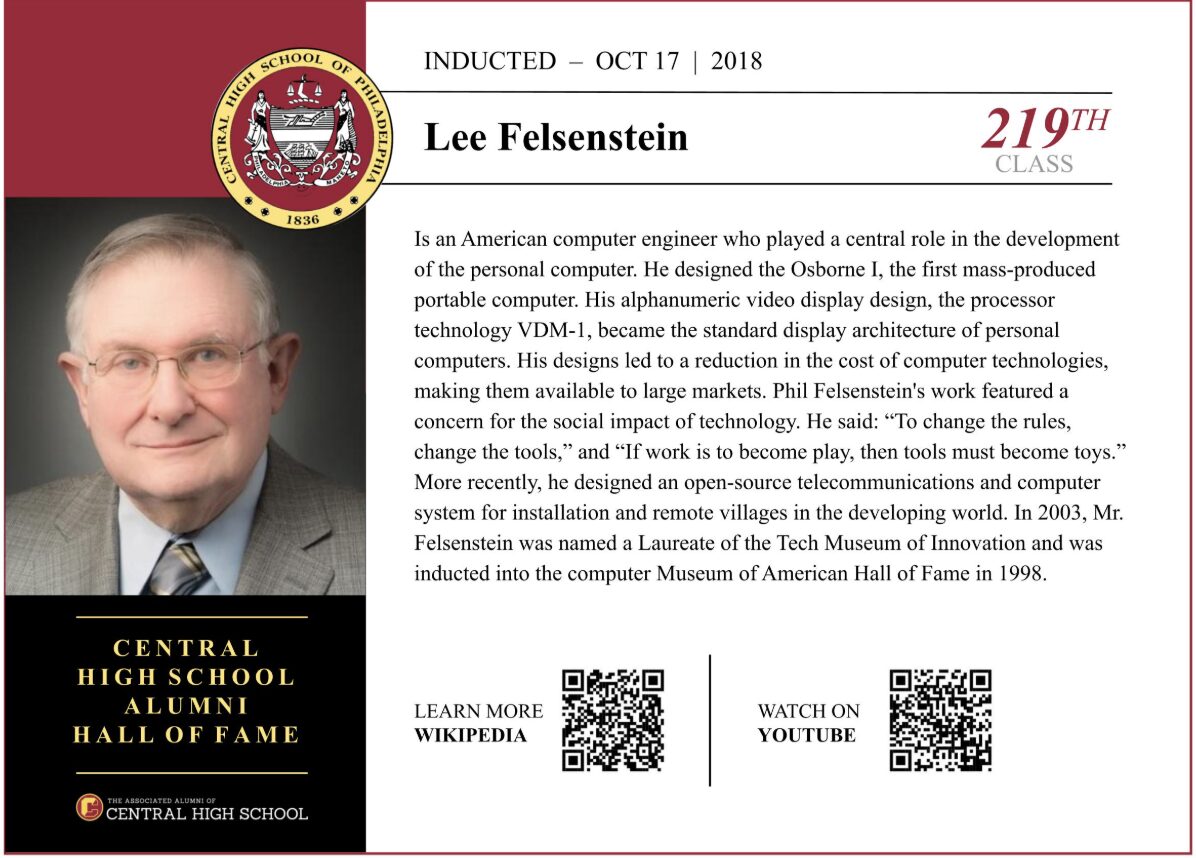
Before personal computers became part of everyday life, Central alumnus, Hall of Fame member Lee Felsenstein (219), was helping shape the future of technology. His work as an engineer, designer, and advocate for accessible computing helped influence the evolution of personal technology and the digital world we know today.
His involvement in the development of early personal computing set the foundation to modern gaming, software development, and digital culture. Mr. Felsenstein is an innovator, engineer, and product development leader with decades of experience creating and bringing new technologies to market. He has conceptualized and designed electronic products across generations of technology, from vacuum tubes to modern microprocessors, and has managed every stage of product development from initial concept through production.
With experience in startup environments, intellectual property management, new technology development, and market creation, Mr. Felsenstein has built and led design teams focused on transforming ideas into successful products. His expertise spans electronic system design, device and circuit development, and strategic product innovation, with a career dedicated to advancing technology and shaping new industries.
By sharing stories like Mr. Felsenstein’s, AACHS celebrates the achievements of our alumni while inspiring current students and future generations. These stories remind us of the extraordinary impact Central graduates have made and encourage our alumni community to stay connected, share their experiences, mentor students, and support opportunities that strengthen Central’s future.
Innovation starts at Central, and we need to invest in the next innovators. Through the AACHS Leading the Way Campaign, we have the opportunity to provide students with the resources, programs, and experiences they need to explore their passions, develop their talents, and become the leaders, creators, and changemakers of tomorrow.